
Early Help
NYSCP Early Help Strategy
The North Yorkshire Safeguarding Children Partnership (NYSCP) is currently undertaking a review of its Early Help Strategy to ensure full alignment with the emerging Families First Partnership Programme guidance.
The Partnership recognises and welcomes the significant reforms being introduced across the children’s safeguarding and wellbeing system. These changes represent a positive shift towards a more integrated, family-centred approach, designed to ensure that children receive the right help at the right time and that safeguarding responses are proportionate, timely, and effective.
During this transition period, North Yorkshire’s Safeguarding Children Partnership is working with partners across the county to reflect the new national expectations, strengthen multi-agency collaboration, and embed a shared understanding of thresholds. This work will support improved identification of need, more consistent decision-making, and better outcomes for children, their families and their networks.
An updated Early Help Strategy will be published once this review is complete. In the meantime, partners should continue to apply professional curiosity alongside existing guidance, while remaining mindful of the direction of travel set out in the national Families First reforms.
What is Early Help?
Early Help is not a designated team; it is the way that everyone works together to support the needs of families.
The aim of Early Help is to build on people’s strengths and resources to manage their own dilemmas, resolve their own difficulties and prevent further problems in the future. Early Help is the response offered by all services in contact with children, young people and families when an unmet need is identified as identified in Working together to Safeguard Children.
NYSCP Early Help Strategy
The North Yorkshire Safeguarding Children Partnership (NYSCP) is currently undertaking a review of its Early Help Strategy to ensure full alignment with the emerging Families First Partnership Programme guidance.
The Partnership recognises and welcomes the significant reforms being introduced across the children’s safeguarding and wellbeing system. These changes represent a positive shift towards a more integrated, family-centred approach, designed to ensure that children receive the right help at the right time and that safeguarding responses are proportionate, timely, and effective.
During this transition period, North Yorkshire’s Safeguarding Children Partnership is working with partners across the county to reflect the new national expectations, strengthen multi-agency collaboration, and embed a shared understanding of thresholds. This work will support improved identification of need, more consistent decision-making, and better outcomes for children, their families and their networks.
An updated Early Help Strategy will be published once this review is complete. In the meantime, partners should continue to apply professional curiosity alongside existing guidance, while remaining mindful of the direction of travel set out in the national Families First reforms.
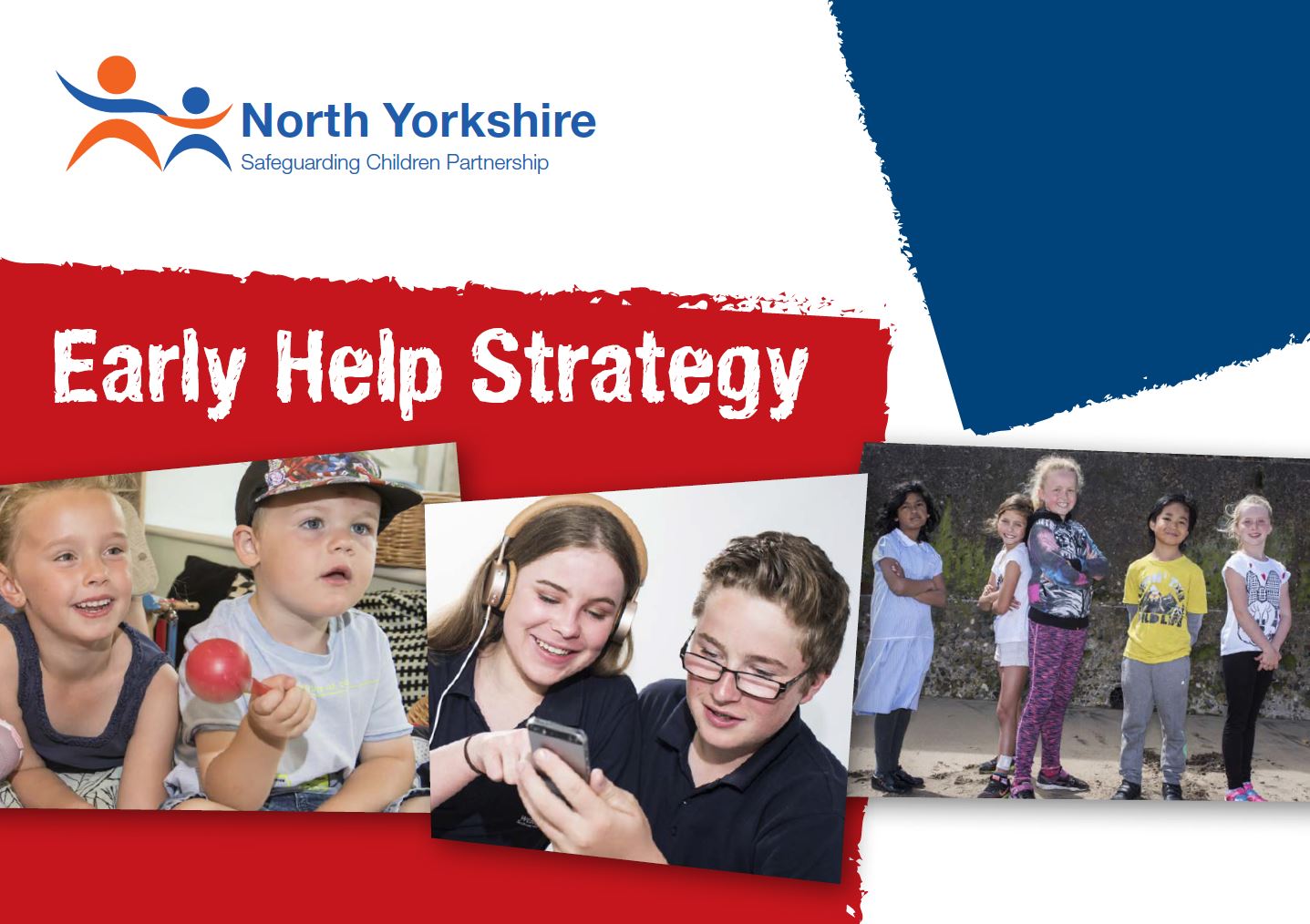
Click on the image to access the North Yorkshire Early Help Strategy:
Who can support this process?
In the early stages of emerging need, the most appropriate person to offer support is often the person who knows the child and family the best. This can be a person from any agency. To support this process there are Locality North Yorkshire Council (NYC) Early Help Consultants based across North Yorkshire. Their role is to offer support, advice and guidance to all Practitioners in the early help system.
What is the Early Help Assessment?
The Early Help Assessment is a strengths based assessment tool which can be used by all Practitioners in North Yorkshire to assess the individual needs of a child and their family. Completing the assessment tool with a child and their family enables the practitioner to understand what is already working well within the family network and what support is already in place whilst identifying worries and any unmet need, enabling the right support to be put in place. Once the assessment is completed the practitioner discusses with the family what steps need to be taken to support their identified need, agreeing whether the support can be met by the Practitioner and their single organisation or if other services are required. If other services are required, the Practitioner (sometimes known as Early Help Champion or Lead Practitioner) can coordinate a Team Around the Family meeting (sometimes abbreviated to a ‘TAF’ Meeting).
The practitioner, on behalf of the child, young person or family, will coordinate the Early Help Assessment and plan. This is intended to provide the family with the right support at the right time, which if offered at an early enough point to prevent difficulties from escalating and have a hugely positive impact.
Team Around the Family
A Team Around the Family meeting engages effectively with the family and relevant professionals to produce a plan of coordinated support that enables a child or young person and their family to achieve agreed outcomes within specified timescales. Prior to calling a TAF meeting, the Practitioner who has completed the assessment should contact one of their locality Early Help Consultants to ensure that the family are not already open to Children and Families Service and that a plan is not already in place. The Consultant will provide this information and also advise the Practitioner of the next steps.
Once the Team Around the Family meeting has been held the practitioner will be required to notify NYC that a Team Around the Family is in place. Further notification will be required once all actions are completed and the TAF is closed.
Request for Additional Support from NYC Children and Families Service
The completed Early Help Assessment form can be used to request additional support from Children and Families Service where it is identified that there is an unmet need and targeted support for families is required. Practitioners are required to discuss the assessment with the Early Help Consultant. It may be useful to refer to the North Yorkshire Safeguarding Children Partnership’s Threshold Guidance to aid these discussions. Practitioners must complete as much information as possible on the Request for Additional Service form and ensure consent is gained from the family to make the referral. Any gaps in information may lead to delay, or result in requests being returned.
The Universal referral form will continue to be available to use, but where there is an early help assessment in place you are able to use this form instead to avoid duplication.
If there is an immediate safeguarding concern the universal referral form should continue to be used in the same way.
Helpful Links
www.safeguardingchildren.co.uk
NYC Locality Contact Details
Early Help – Central
Selby, Hambleton, Richmondshire
01609 534829
earlyhelpcentral@northyorks.gov.uk
Early Help – West
Harrogate, Knaresborough, Ripon, Craven
01609 534842
earlyhelpwest@northyorks.gov.uk
Early Help – East
Scarborough, Whitby Ryedale
01609 534852
earlyhelpeast@northyorks.gov.uk
Updated May 2026


 View all our news