

Child Protection Medical Assessments
In the discussions in all cases, consideration must be given to how the child and any siblings will be safeguarded whilst awaiting the assessment. Facilitation of safeguarding arrangements alone is not an indication to perform an emergency out-of-hours assessment.
Out of Hours Requests for Child Sexual Abuse Medical Assessments (Weekends/Bank Holidays and Monday to Friday 17:00 – 09:00)
Please see the separate Safeguarding Partnership Guidance on Child Sexual Abuse Medical Assessments. Expert professional advice regarding whether a Child Sexual Abuse Medical Assessment is required can be obtained from the commissioned Child Sexual Assault Assessment Service (CSAAS), Mountain Healthcare 0330 223 0099.
Child Protection Medical Assessments
A Child Protection Medical Assessment is a medical assessment which is undertaken either at the request of Children’s Social Care or the Police, or when a referral has been or is about to be made by a Paediatrician to Social Care in the context of concerns for the wellbeing of a child already receiving clinical care. It is a comprehensive assessment which includes the clinical history and examination, and detailed documentation including the use of line drawings and photo documentation. Additionally, the assessment includes obtaining any relevant investigations, arranging any necessary aftercare, and writing a report with an opinion (RCPCH 2020).
The need for a Child Protection Medical Assessment to be completed should always be considered where there has been a disclosure or there is a suspicion of any form of abuse to a child.
A Child Protection Medical Assessment should demonstrate a holistic approach to the child and should include a basic assessment of the child’s well-being, including mental health, development and cognitive ability.
A Child Protection Medical Assessment is necessary to:
- Identify the child’s health needs.
- Help to reduce the physical and psychological sequelae of such abuse.
- Determine the likelihood of child abuse on the balance of probability.
- Facilitate the Police investigation of a possible crime by documentation of clinical findings, including injuries. Child sexual abuse medicals may include taking samples that may be used as forensic evidence in a Police investigation relevant to all types of abuse. If forensic samples are needed in other child protection medicals these need doing in accordance with a chain of evidence process. Where Trusts do not have an internal agreed process, this should be done in conjunction with the Police to maintain the chain of evidence.
- Contribute to the multi-agency assessment through sharing of information.
Child Protection Medical Assessments should be carried out by paediatric clinicians who meet the requirements outlined in the Intercollegiate Document (2025) Safeguarding children and young people & children and young people in care: Competencies for health care staff. Only doctors may physically examine the whole child for the purpose of child protection. All other staff should only note any visible marks or injuries on a body map and record, date and sign details in the child’s medical records.
Where possible the child or young person should be accompanied and supported by an adult with parental responsibility if safe to do so.
The child must also be accompanied by a Social Worker who has knowledge about the concerns that have led to the child protection medical and details of the family composition. Sometimes this will be the duty Social Worker, but they should have been provided with the necessary information.
Child Protection Medical Assessments should be carried out in the presence of a chaperone. The chaperone should be a trained health professional who is there as a witness and to support the child and clinician. Their name should be recorded on the Child Protection Medical Assessment proforma.
Consideration should be given to support for both the child and family during the Child Protection Medical Assessment, e.g., use of interpreters or support for children with disabilities.
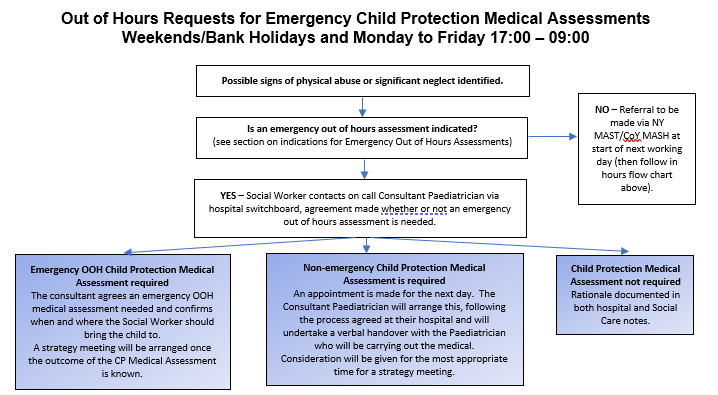
Emergency Child Protection Medical Assessments (Out of Hours)
Wherever possible, Child Protection Medical Assessments should be performed in working hours.
It is recognised that sometimes following a strategy discussion between the Police and Social Care, assessments may need to be performed as an emergency out of hours.
A record of emergency out of hours assessments should be kept.
Emergency out of hours assessments should not be arranged unless there has been a direct discussion between the Consultant Paediatrician and the Social Worker. Where the Consultant Paediatrician involved in initial discussions is not the Consultant who will be performing the assessment, there must be a verbal handover between Consultants.
Current recommendations state that Child Protection Medical Assessments should be performed within 24 hours of the referral from Social Care. It is recognised that referrals received on a Friday or on a Saturday will need to be processed differently to those received on other days. The threshold for performing an emergency out of hours assessment will need to be lower to ensure that this standard is reached.
Indications for emergency out of hours assessments include, but are not limited to:
- Any non-mobile baby with suspected physical abuse. These babies require a more urgent medical assessment and are very likely to require further investigations.
- Any suspected physical abuse where the injury is unlikely to be visible within the next 24 hours. Please note this does not apply to most bruises as they tend to take several days to resolve.
During discussions regarding emergency out of hours assessments, consideration must be given as to how the child, and any siblings will be safeguarded pending assessment. Facilitation of safeguarding arrangements alone is not an indication to perform an emergency out of hours assessment.
The strategy meeting following an emergency out of hours assessment will usually be held in normal working hours unless more urgent conversations are required about immediate safety planning. Best practice is for the Paediatrician who has completed the Child Protection Medical Assessment or the Paediatrician who has the best knowledge of the child to attend the Strategy Meeting. To achieve this the timing of the meeting will need to be planned to take into account their other clinical commitments.
Acute Illness or Injury
Child Protection Medical Assessments must not be used as a route to seek medical attention for acute illness or injury. Where acute illness or injury is suspected (e.g. a fracture), established pathways for management of the injury should be followed (e.g. attending the Emergency Department). Any safeguarding concerns should be communicated to the treating team and the usual processes for arranging a Child Protection Medical Assessment should be followed.
Consent
Informed consent should be taken for each Child Protection Medical Assessment; ideally this will be written consent, but when consent is being obtained over the telephone, documentation that verbal consent was given should be written in the child’s medical record. Best practice is that consent would be given following consultation and agreement with an adult with parental responsibility.
The following people may give consent to a Child Protection Medical Assessment:
- The child or young person if they are deemed to have capacity.
- Any person with parental responsibility (PR), providing they have the capacity to do so.
- The local authority when the child is the subject of a care order (though the parent should be informed).
- The High Court when the child is a ward of court.
- A Family Proceedings Court as part of a direction attached to an Emergency Protection Order, an Interim Care Order or a Child Assessment Order.
- If consent is withheld for any part of the assessment, including examination, photography or investigation then this is recorded, including subsequent discussions and any actions taken.
If a strategy meeting/discussion has recommended a Child Protection Medical Assessment but the person with parental responsibility refuses to give consent, the professionals involved should consider the case in its entirety. If they decide the examination is in the child’s best interest and/or there is a public interest, then they should refer to the local authority to seek legal advice to consider next steps. Advice will also be taken from senior colleagues to ensure that the right and most proportionate action is taken depending on the circumstances for the individual child. The local authority can only override the refusal of the adult with parental responsibility by a court order.
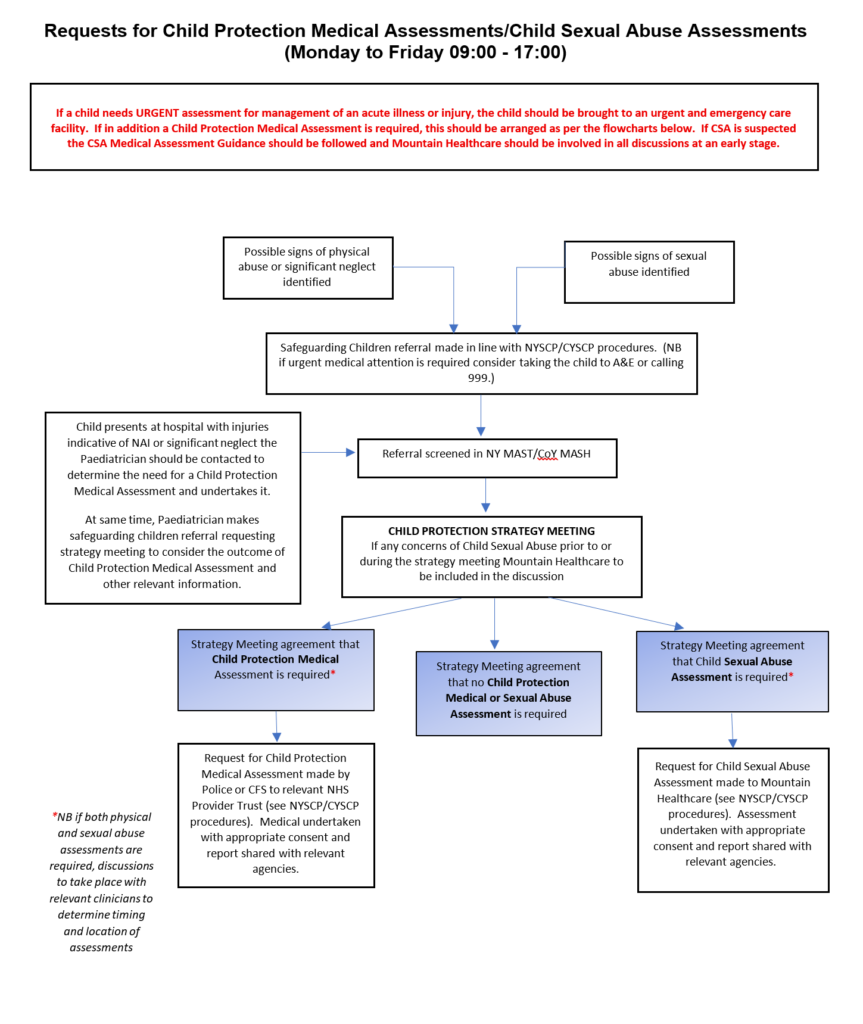
Arranging the Child Protection Medical Assessment/Child Sexual Abuse Assessment (Monday to Friday 09:00 – 17:00)
Child Protection Medical Assessments can be requested as an action arising from a strategy meeting or prior to the strategy with the intention of informing the discussions during the meeting. A Child Protection Medical Assessment should not be requested to determine if a strategy meeting is required.
The strategy meeting must consider, in consultation with the Paediatrician, the need for and the timing of a Child Protection Medical Assessment.
In cases where there are concerns that a child or young person may have experienced sexual abuse a representative from the Child Sexual Assault Assessment Service (CSAAS) should be in attendance at the strategy meeting to offer advice. If the concern about child sexual abuse only becomes evident during the strategy meeting it is sometimes possible for a representative from the CSAAS to be dialled into the meeting. If this is not possible and it is decided that a CSAAS medical is required the referral from the Social Worker to CSAAS should include the minutes of the strategy meeting. Any sexual abuse medicals should be undertaken by the CSAAS.
All Child Protection Medical Assessments should be carried out within timescales appropriate to the type of abuse and the requirement for collection of evidential samples:
- Physical injury: ideally within 24 hours, and if not possible, advice should be gained from a Paediatrician around next steps.
- Acute sexual assault: as soon as possible to obtain forensic evidence and prevent pregnancy and infection.
- Historic sexual abuse, neglect, or emotional abuse: the referral should be assessed according to clinical need and requirement of the child protection process. Children should not be kept waiting for more than 10 working days from the point of referral, unless there are clear mitigating factors agreed by all parties.
- Where Police investigation or protection from harm is required: ideally within 24 hours.
If these standards are not met, then the reasons should be clearly recorded in the child’s health record. If there is a delay in undertaking the medical assessment, there needs to be consideration/agreement of an appropriate safety plan and placement of the child and siblings until the medical takes place.
Either the Police or Children’s Social Care can request a Child Protection Medical Assessment. The assessment should be arranged with the nearest acute provider of paediatric services.
Arranging an Emergency Child Protection Medical Assessment – Out of Hours (Weekends, Bank Holidays and Monday to Friday 17:00 – 09:00)
The Social Worker should contact the on-call Consultant Paediatrician via the Hospital switchboard.
An agreement should be reached as to whether an emergency out of hours medical assessment is required or whether an appointment can be made for the next day. This discussion must include details as to how the child will be safeguarded pending assessment.
If an appointment is required for the next working day, the Consultant Paediatrician must arrange this following the process agreed at their hospital.
All discussions must be documented in the patient notes/electronic patient record.
Non-medical Supervision
When a child undergoing Child Protection Medical investigations requires supervision on non-medical grounds, it is the responsibility of children’s social care to arrange that supervision.
Female Genital Mutilation
If FGM is suspected please refer to the specific guidance on this subject which can be found on the on the relevant Safeguarding Children Partnership website.
Child Protection Service Delivery Standards
The Child Protection Delivery Standards state that a clinician with appropriate expertise should be available within a reasonable period of time, during normal working hours, to engage with partner agencies in a strategy discussion regarding the potential need for medical assessment, safe care plan arrangements and further steps. Such availability will need to be factored into job planning.
Child Protection Medical Assessments should be completed in line with good practice service delivery standards (RCPCH, 2020).
Child Protection Medical Reports
The assessment, professional opinion and outcome resulting from a Child Protection Medical Assessment should be clearly recorded and communicated to the requesting professional as well as to the family and child as appropriate.
A provisional medical opinion should be given in writing to the accompanying Social Worker (and the Police officer if present) at the time of the child protection medical and copied in the notes. The full report must be typed and signed as soon as possible and should be available within ten working days of the assessment.
The child protection medical report should be completed in accordance with the guidance in the RCPCH Child Protection Companion.
All reports and diagrams should be signed and dated by the doctor undertaking the examination.
Telephone Numbers
Harrogate Hospital: 01423 885959 – and ask to speak to the Paediatrician on call.
York Hospital: Monday – Friday 09:00 – 16:30hrs contact the York Hospital Safeguarding Children Team: 01904 726647 / All other times call 01904 631313 and ask to speak to the Paediatrician on call.
Scarborough Hospital: Monday – Friday 09:00 – 16:30hrs contact the Scarborough Hospital Safeguarding Children Team: 01904 726647 / All other times call 01723 368111 and ask to speak to the Paediatrician on call.
Hambleton and Richmondshire: Monday to Friday 09:00 – 17:00hrs (excluding bank holidays) ring the Friarage Hospital on 07977 047614. At other times ring James Cook University Hospital, Middlesbrough on 01642 850850 and ask to speak to the Paediatrician on call. See Appendix One (below) for Normal Working Hours and Out of Hours Referral Pathways for Hambleton and Richmondshire.
Airedale – for children living in Craven: Monday – Friday 08:30 – 16.30hrs ring the Paediatric Secretarial Team on 01535 292434. The medical will be done in Children’s Outpatients, Building 22, location B20 at Airedale Hospital. Out of hours: ring Airedale Hospital switchboard on 01535 652511 and ask to speak to the Consultant Paediatrician on call. Out of hours medicals are carried out on the Children’s Ward, Ward 17, Location C20 at Airedale Hospital.
Child Sexual Assault Assessment Service (CSAAS): ContactMountain Healthcare on 0330 223 0099 – 24 hours.
Please note when calling a Paediatrician on call they will be responsible for all emergency paediatric care, medical provision to the children’s ward and neonatal unit and will need to prioritise the urgency of the medical with the work in the hospital at the time.
References
Child Protection Companion (RCPCH) – live on RCPCH website.
Intercollegiate Document (2025) Safeguarding children and young people & children and young people in care: Competencies for health care staff – available on RCPCH website.
Child protection service delivery standards (RCPCH 2020) – available on RCPCH website.
Appendices
Appendix One – South Tees Referral Pathways for Hambleton and Richmondshire


Page reviewed: June 2026


 View all our news